
Why Protein Quality Beats Protein Quantity

You’re hitting your numbers. Every day, like clockwork, you log your meals and land right on your protein target. And yet your recovery’s still dragging and your lifts have stalled.
Here’s the thing nobody tells you: the gram count on your tracker doesn’t actually tell you much. Two people can eat identical amounts of protein and get completely different results, because what kind of protein you eat matters almost as much as how much.
Not All Protein Is Created Equal
Protein is really just a bundle of amino acids, and nine of them — the essential ones — your body can’t make on its own. You have to eat them. Animal sources (eggs, dairy, meat) usually contain all nine in good amounts. Most plant sources are missing one or two. Rice is short on lysine, beans are short on methionine, and so on.
That’s not a reason to avoid plants — pairing rice with beans, for example, fills the gap. But if you’re not thinking that carefully about it and you’re mostly stacking incomplete sources, you can hit your number on paper while your body quietly falls short in practice.
There’s also a digestibility question: how much of what you eat actually gets absorbed and used? Whey and casein score at the top of the scale here; most plant proteins score noticeably lower. So 160 grams logged isn’t always 160 grams used.
Source and Processing Actually Matter
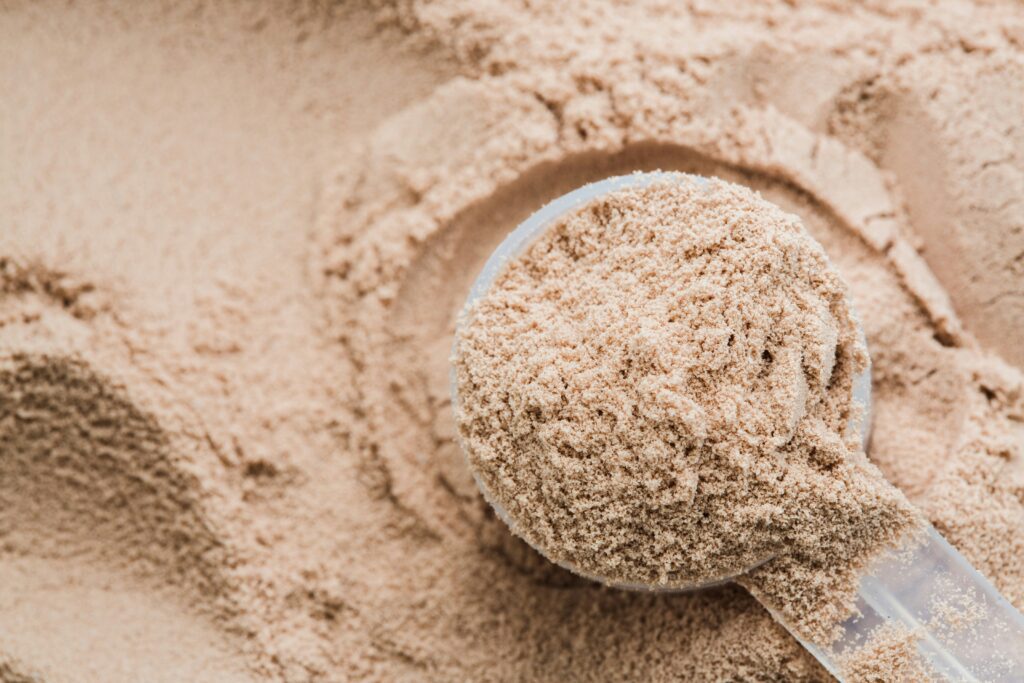
A protein’s quality starts before it ever hits a label. Grass-fed dairy, for instance, tends to come with a better nutrient profile than grain-fed — and that carries through into the whey protein made from it.
Processing is where a lot of products quietly lose value, too. Heavy heat treatment and a long list of fillers, additives, and “proprietary blends” can water down how much usable protein you’re really getting per scoop. The simplest gut check: if the ingredient list reads like a chemistry exam, that’s worth a second look. Short list, clear source, third-party tested — that’s the bar.
The Leucine Thing You’ve Probably Never Tracked
One amino acid, leucine, does a lot of the heavy lifting for muscle repair. There’s a rough threshold — somewhere around 2-3 grams per meal — your body needs to actually flip the “build muscle” switch. A 30-gram scoop of whey usually clears that bar easily; a lot of plant proteins fall short gram-for-gram.
A 2017 study in the Journal of the International Society of Sports Nutrition backed this up, finding leucine content was a bigger driver of muscle repair than total protein alone. If you’re stacking multiple WODs or training sessions a week, that per-meal signal is doing more work than your daily total ever will.
Timing Counts Too
Whey digests fast, which makes it a solid post-workout choice when your body’s primed to use it. Casein digests slow, which makes it better suited for overnight, when you’re fasting for hours anyway. Get this backwards — say, a slow-digesting source right after training — and you can leave recovery on the table even when your total numbers look fine.
A Quick Audit Worth Running
For one week, instead of just logging grams, log sources. Note which meals are built on complete, high-quality protein and which are leaning on incomplete or heavily processed ones. You’ll probably spot a pattern fast.
Then try a simple swap: replace one lower-quality source with a cleaner one — a grass-fed whey instead of a filler-heavy blend, for example — and hold everything else steady for a month. Watch your recovery and soreness. Let the results make the case.
Bottom Line

Hitting your protein target is a fine starting point, but it’s not the finish line. Pay attention to where your protein comes from, hit your leucine mark at key meals, and match the type to your timing. Get the quality right, and the quantity tends to take care of itself.
